INTRODUCTION TO LECTIO DIVINA PART 3: MEDITATIO
Reading in spirit and truth
What is lectio divina? Content, structure, underlying principles
Stage 2, meditatio or meditation
The aim of this second stage in the lectio divina exercise is to relate the specific text to life. There is, therefore a progression from an objective approach to Scripture, aimed at reading and understanding the basic literal meaning of the text, to the more subjective reflection on how the text relates to our own spiritual journey and life in general. Each person asks himself how the text can help his discipleship, his relationship with the living Lord. We progress from what the text says in and of itself to what the text says to us, to our life, to our personal journey of faith. We are going through the stages of information, formation and transformation or from one type of soil to another until we reach the rich soil below referred to in the parable of the sower.
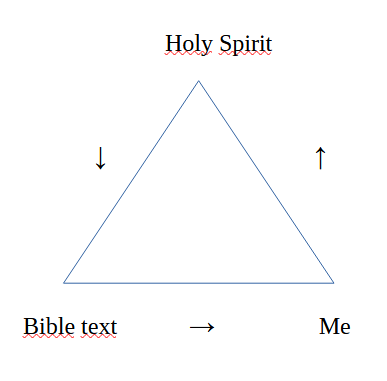
In this second stage we ask ourselves questions such as ‘how do I fit into what I have read’? ‘What is the Holy Spirit saying to me through this text’? ‘How does this text relate to my life, to my circumstances’? We remind ourselves that this is the Word of God, that God is speaking to us personally. Here we are listening, reflecting and meditating. We are no longer struggling with the text; the preparatory work has been done in stage one. Now we prayerfully, calmly and serenely stand back from what the text means in and of itself to draw lessons for life, to listen to what the Holy Spirit is saying, not necessarily to others, but to each one of us personally. This involves humility, a disposition of self-denial, the suspension of a critical attitude towards the text and a willingness to be challenged by the text. We allow the Holy Spirit to mould us, we do not resist. At this stage we are not necessarily adhering to the literal meaning of the text. We meekly allow ourselves to be led by the Holy Spirit as we meditate on the text. We are no longer prevalently engaged in a horizontal relationship with the text, struggling to understand it. It now becomes a triangular relationship - the Holy Spirit, through the passage, reaches out to us personally and we respond.
Scripture becomes present to us. We become part of the narrative. Jesus is no longer speaking to a rich man in some remote time of the past. We are that rich man in Mark 10:17-31. Jesus is speaking to us. He is speaking to us when he says “Come to me, all you who are weary and overburdened, and I will give you rest” (Matthew 11:28). He is no longer speaking to the woman caught in adultery when he says “Neither do I condemn you; go, and from now on sin no more” (John 8:11), he is speaking to us. He is no longer asking Peter three times ‘do you love me?’ (John 21:15), he is asking each one of us personally. And we weep inside because we do not surrender all to Jesus as he asked of the rich man. We decide to accept the invitation to enter into the rest of Jesus and we reply with a resounding ‘yes’ when asked ‘do you love me’. Now is the time to say “Yes, Lord; you know that I love you” (John 21:15).
The birds of the air cannot snatch up this seed that has been sown. When Christ, through the Holy Spirit and through the Bible verses, speaks to us like that we recognise his voice (John 10:27-28) and we follow. We become committed followers of Christ, true disciples. We receive the Word with joy (Matthew 13:20). However, it still has to grow healthy roots.
As we progress and as we continue this exercise on a daily basis we shall gradually get used to relating the text to ourselves and no longer see the text as something detached, as something to be dissected, analysed, criticised. We shall begin to find unity with the text and with the ultimate author of it, the Holy Spirit, and be gradually moulded by the divine potter.
But now, o Lord, you are our Father; we are the clay, and you are our potter; we are all the work of your hand. (Isaiah 64:8)
The transition from the lectio, reading, to the meditatio, meditation stage is from an I-It relationship with the Word to an I-Thou relationship to use the terms of Martin Buber; from a prevalently objective, detached relationship, to a more subjective, personal, involved relationship. Black print on a white background becomes a two edged sword revealing the thoughts and intentions that lie deep down within.
For the word of God is living and active, sharper than any two-edged sword, piercing to the division of soul and of spirit, of joints and of marrow, and discerning the thoughts and intentions of the heart”.
Here we allow the Word to challenge us, to challenge our thoughts, ways and intentions in order to enter into the thoughts and ways of God (Isaiah 55:8, 9):
For my thoughts are not your thoughts, neither are your ways my ways, declares the Lord. For as the heavens are higher than the earth, so are my ways higher than your ways and my thoughts than your thoughts.
Deep inner healing takes place as we let ourselves be guided by the Holy Spirit interacting with our spirit purifying us from within. It is here, and in subsequent stages, that formation and transformation start to take place. We learn who and what we are and what we can become (formation) and the Word works from within to transform us as promised. “He who calls you is faithful; he will surely do it” (1 Thessalonians 5:24). We learn to listen and become more aware of the motions of the Holy Spirit, not only during the exercise of lectio divina but also in our daily lives.
-----------
Part 4 > > > Lectio Divina Introduction Continue to Read > > >
© R W
bsgbiblestudyguide@gmail.com